
The Certificate of Destruction: Your Only Insurance Policy Against Fines
6 min read · 15 December 2025
TL;DR
Executive Summary : The Core Risk: In 2025, data that cannot be proven destroyed is legally considered data that still exists. The Solution: A valid, serialised Certificate of Destruction (CoD) is you
Executive Summary :
- The Core Risk: In 2025, data that cannot be proven destroyed is legally considered data that still exists.
- The Solution: A valid, serialised Certificate of Destruction (CoD) is your only defence against UK GDPR fines and cyber insurance denials.
- The Trap: A "Waste Transfer Note" is not proof of data erasure; it is merely an environmental receipt.
- Immediate Action: Audit your current vendor's Certificate of Destruction template to ensure it includes asset-level serial numbers and references NIST 800-88 Rev 2 or ADISA 8.0.
For many General Managers and SME owners, the disposal of end-of-life IT assets—servers, laptops, and SSDs—is often viewed as a logistical nuisance. It is frequently treated simply as "waste" to be cleared from the loading bay. However, following the enactment of the Data (Use and Access) Act in June 2025 and the tightening of UK GDPR enforcement, this mindset has become a dangerous liability.
It is no longer sufficient to hire a "man with a van" to recycle your electronics and hope for the best. You must possess forensic evidence that the data residing on those devices was irretrievably sanitised. That evidence is the Certificate of Destruction (CoD).
This guide dissects what a valid Certificate of Destruction template must look like in 2025 and explains why a robust ITAD audit trail is your primary insurance policy against regulatory fines.
The "Paper Receipt" Fallacy: Waste Note vs. CoD
The most common compliance failure occurs when businesses confuse environmental paperwork with data privacy documentation. If the Information Commissioner’s Office (ICO) investigates a data breach involving your old hardware, producing a Waste Transfer Note will not save you.
What is the difference?
Data Destruction Compliance Documentation
| Feature | Waste Transfer Note / Bill of Lading | Certificate of Destruction (CoD) |
|---|---|---|
| Primary Purpose | Environmental Compliance (tipping fees, waste tracking). | Data Privacy Compliance (UK GDPR, Data Act). |
| What it Tracks | Weight (e.g., "500kg of mixed electronics"). | Information (e.g., "Hard Drive Serial #5RE4321"). |
| Legal Proof | Proves you didn't fly-tip the hardware. | Proof of data erasure and transfer of liability. |
| Value in Court | Zero for data defence. | High (if serialised). |
The Risk: A Waste Transfer Note confirms you handed the devices to a third party. It does not confirm that the data was destroyed. If that third party loses a drive in transit, you remain liable for the breach. Relying on transport paperwork is a primary reason for cyber insurance claim denials under "failure to maintain controls" clauses.
Anatomy of a Valid Certificate of Destruction Template (2025)
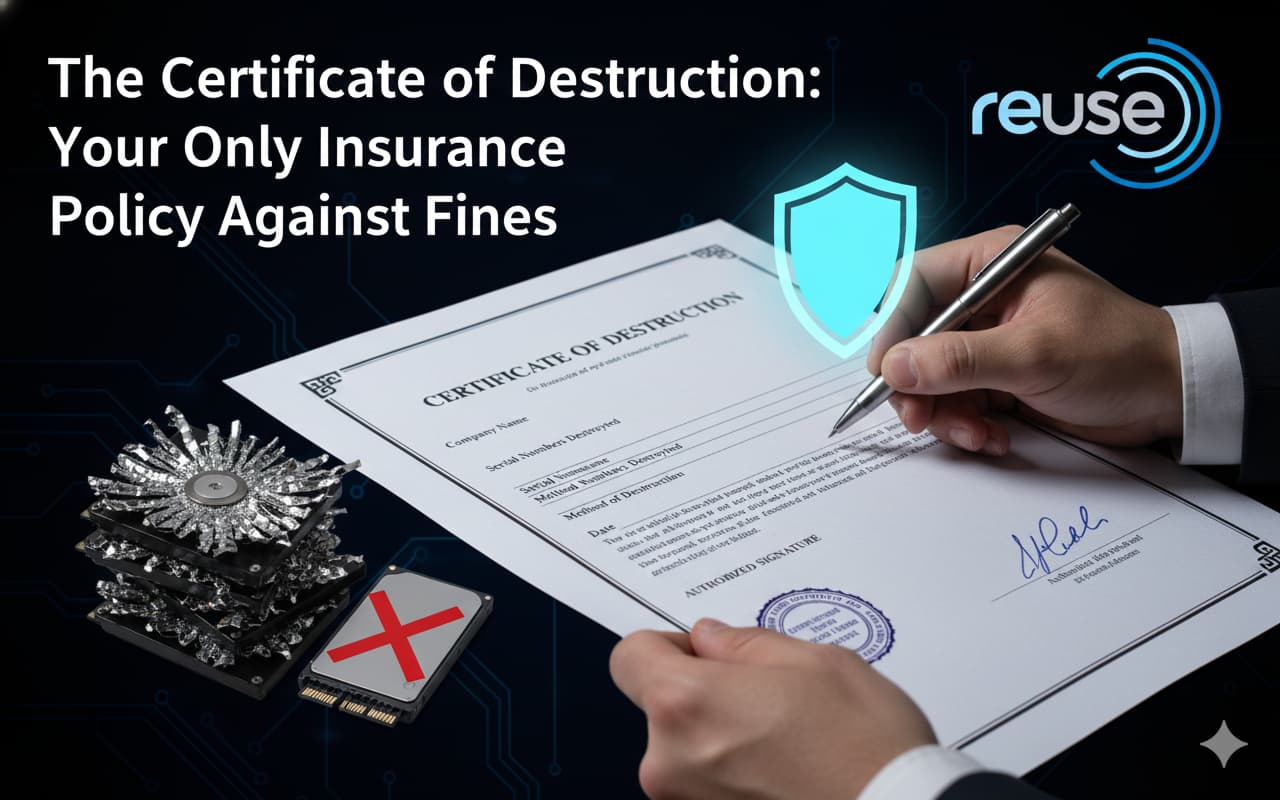
If you are evaluating an IT Asset Disposition (ITAD) partner, you must audit their reporting standards before signing a contract. A legally defensible Certificate of Destruction template must contain specific, granular data fields. If the document lacks these pillars, it is legally porous.
To satisfy the ITAD audit trail requirements of 2025, ensure your certificate includes:
1. Asset-Level Serialisation (The "Golden Thread")
This is the single most critical element. A certificate that merely lists "20 Hard Drives" is unacceptable. It must list the specific Manufacturer, Model, and Serial Number of every single drive.
- Why it matters: If a drive containing payroll data is found on eBay, you must be able to search your CoD for that specific serial number. If it is on the list, the liability shifts to your vendor. If it is not, the liability remains with you.
2. The Methodology Statement (NIST & ADISA)
The document must explicitly state the methodology used. Vague terms like "processed" or "recycled" are red flags.
- The 2025 Standard: Your certificate should cite compliance with NIST SP 800-88 Revision 2 (specifically differentiating between "Purge" and "Destroy" methods) or the ADISA Asset Recovery Standard 8.0.
- Media Specifics: It must confirm that Solid State Drives (SSDs) were shredded to a specific particle size (e.g., <10mm) or cryptographically erased. Note: Standard degaussing does not work on SSDs; if your certificate says "Degaussed" for an SSD, the data is likely still intact.
3. Transfer of Liability Clause
The certificate is a contract. It should contain a clear indemnification clause stating that the ITAD vendor accepts full liability for the data from the point of hand-off. This legal language turns the document into a true insurance policy.
4. Verified Signatures and Dates
An automated printout is insufficient. The document requires a signature from the technician who performed the destruction and a timestamp of when the final erasure occurred.
The Cost of Failure: Case Studies & Insurance
The financial risks of improper disposal have escalated. In 2025, we have seen enforcement actions where the lack of an audit trail was the primary aggravating factor.
The Morgan Stanley Precedent
The £120m+ ($161.5m) fines levied against Morgan Stanley serve as the ultimate warning. Their failure was not just losing devices, but the inability to produce a valid ITAD audit trail for the assets they decommissioned. Because they hired a moving company rather than a specialist, they could not prove what was destroyed and what was lost.
Cyber Insurance Denials
Insurers are aggressively closing loopholes. If your business suffers a breach via a retired asset and you cannot provide proof of data erasure, your cyber liability policy may be voided. Insurers view the lack of a CoD as negligence, triggering "failure to maintain minimum security standards" exclusions.
Action Plan for General Managers: The Reconciliation Process
The most common operational mistake is filing the CoD without looking at it. To make this document useful, you must perform Reconciliation.
The Workflow:
- Create an Internal List: Before the van arrives, generate a list of serial numbers from your own asset register.
- Audit Your Vendor: Demand a sample Certificate of Destruction template before booking. If it lacks serial numbers, change vendors.
- Match the Lists: When the CoD arrives, compare it against your internal list.
- Flag Discrepancies: If you sent 100 drives but the CoD only lists 99, you have a "Phantom Asset." You must investigate immediately. That missing drive is your liability.
- FAQ's
Is a Waste Transfer Note the same as a Certificate of Destruction?
No. A Waste Transfer Note tracks environmental disposal (weight), whereas a Certificate of Destruction tracks data liability (serial numbers). You need both, but only the CoD provides proof of data erasure.
What is the legal retention period for a Certificate of Destruction?
Under the UK Data Protection Act and corporate audit laws, it is recommended to retain these records for a minimum of 5 to 7 years to align with audit cycles and potential litigation windows.
Can I use a free recycling service for business IT equipment?
“Free” services often fund themselves by reselling your equipment. Unless they provide a serialised ITAD audit trail and certified erasure, the risk of a data breach far outweighs the cost savings.
No. A Waste Transfer Note tracks environmental disposal (weight), whereas a Certificate of Destruction tracks data liability (serial numbers). You need both, but only the CoD provides proof of data erasure.
Under the UK Data Protection Act and corporate audit laws, it is recommended to retain these records for a minimum of 5 to 7 years to align with audit cycles and potential litigation windows.
"Free" services often fund themselves by reselling your equipment. Unless they provide a serialised ITAD audit trail and certified erasure, the risk of a data breach far outweighs the cost savings.
Contact Reuse Technology Group Today
Your paper trail is your only insurance policy.
The lack of a serialised Certificate of Destruction (CoD) is a direct threat to your UK GDPR compliance and risks voiding your cyber insurance. Don't face a regulatory fine over a "Phantom Asset."
Secure your liability today.
Contact our certified ITAD experts through the form below to audit your compliance and establish a watertight, legally defensible ITAD audit trail.