
Onsite vs. Offsite Hard Drive Shredding: A B2B Security and Compliance Guide
12 min read · 8 December 2025
TL;DR
For businesses navigating data lifecycle management, retiring old hardware is often the weakest link in an organisation’s security chain. For Chief Information Security Officers (CISOs) and IT Directo
For businesses navigating data lifecycle management, retiring old hardware is often the weakest link in an organisation’s security chain. For Chief Information Security Officers (CISOs) and IT Directors, the moment a hard drive leaves the live network and is marked for disposal, the risk profile changes dramatically. You face a crucial decision: utilising onsite hard drive shredding (Mobile Shredding) or opting for offsite hard drive shredding (Facility-Based Shredding).
This guide breaks down the security, compliance, and cost factors you must consider to make an informed, risk-adjusted data destruction decision for your business.
The Compliance Anchor: Why Physical Destruction is Mandatory
Reuse after data sanitisation is the ideal, but if organisational security compliance requires it, then physical hard drive destruction is the definitive, auditable method. It provides a guaranteed, auditable endpoint, ensuring data can never be recovered. It provides a guaranteed, auditable endpoint, ensuring data can never be recovered. Relying solely on software wiping (data wiping) is often insufficient for high-security environments or for damaged media. However, it is important to note that while hard drive shredding removes the possibility of asset reuse, the decision to opt for it must be based on genuine organisational security requirements rather than simply being a lazy option.
Your destruction policy must adhere to international and domestic standards for data security:
- NIST SP 800-88 Rev. 1: This is the foundation for secure media sanitisation. Physical destruction (shredding, crushing) falls into the ‘Destroy’ category, which is the ultimate assurance that all data is irretrievable.
- GDPR (General Data Protection Regulation): GDPR Article 32 requires organisations to implement “appropriate technical and organisational measures” to protect personal data. The choice between onsite hard drive shredding and offsite hard drive shredding must demonstrate that the risk of destruction failure—whether technical or logistical—has been mitigated appropriately.
- Industry Regulations (HIPAA, PCI DSS): For sectors like healthcare and finance, stringent regulations mean that failure to prove secure disposal can lead to severe fines and reputational damage.
Hard drive shredding provides the Certificate of Destruction (CoD). This is your legally binding 'gold standard' document, formally transferring operational liability away from your organisation. A compliant CoD must list the serial numbers of all destroyed drives, the date, and the location of destruction.
Onsite Hard Drive Shredding: Maximum Control, Zero Transit Risk
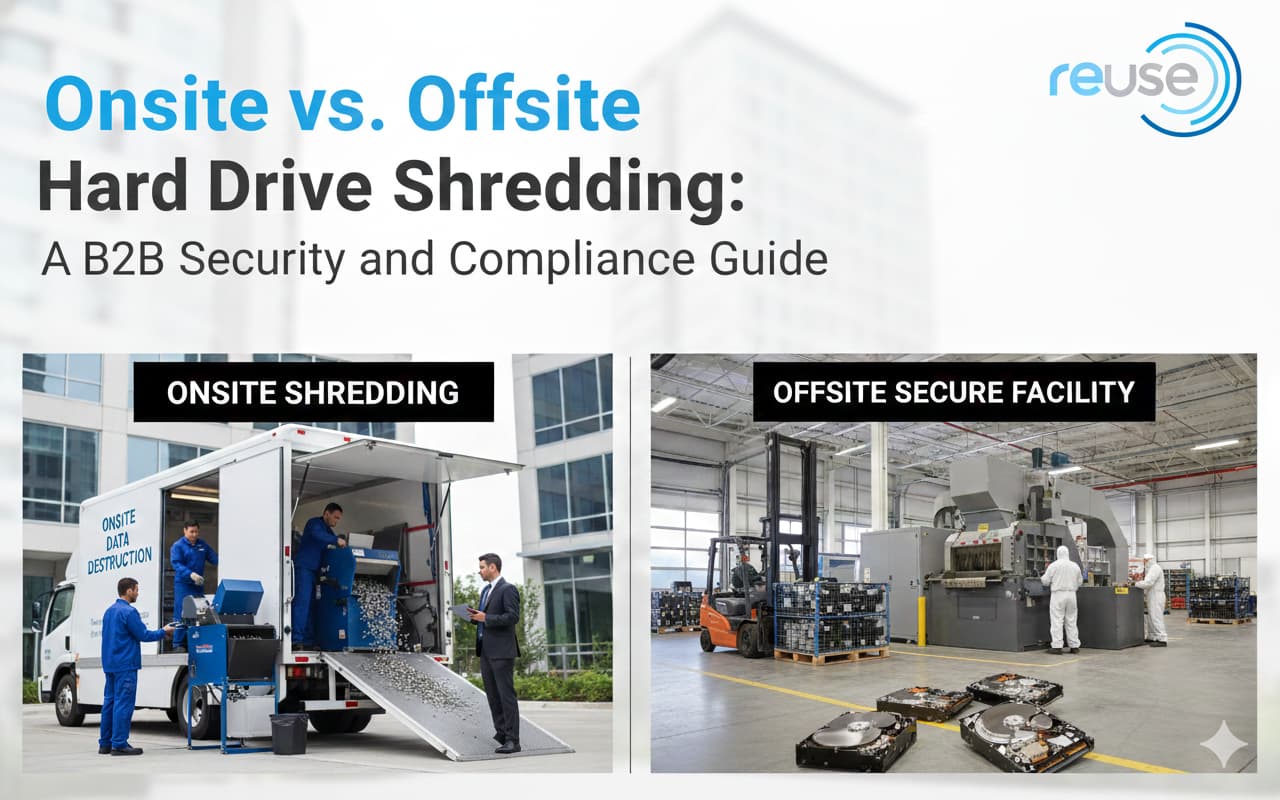
On-site hard drive shredding, also known as mobile shredding, means the destruction company brings a secure, specialised truck directly to your location (e.g., your data centre or office car park). The devices are destroyed immediately, on your premises.
The Security Benefits of Onsite Destruction :
- Immediate Chain of Custody (CoC) Closure: This is the paramount advantage. No devices containing sensitive information leave your premises intact. The entire lifecycle—from asset retirement to final destruction—remains within your secure environment.
- Elimination of Transit Risk: By destroying assets before they leave your property, your onsite hard drive shredding process achieves zero transportation risk. This removes the single largest vulnerability in the asset disposition lifecycle: loss or theft while assets are being moved.
- Visible Proof: Your security team can witness the entire process firsthand, often via a closed-circuit television monitor mounted on the shredding truck. This transparency offers critical client reassurance and strengthens internal audit procedures. This method is often preferred for government, defence, or financial institutions handling extremely sensitive data.
The Practical Considerations (Drawbacks)
- Higher Cost for Low Volume: On-site hard drive shredding services can be more expensive than Off-Site options, especially for smaller batches, due to the inherent costs of mobilising specialised equipment (e.g., fuel surcharges and transportation fees).
- Operational Disruption: Mobile shredding units require site access, power, and space, and the process can cause temporary disruption due to noise and logistics.
- Scheduling Constraints: Mobile shredder availability may affect your required destruction timelines.
- Removes reuse and circularity and sustainability, even though there can be material recovery after shredding.
Offsite Hard Drive Shredding: Cost Efficiency and Technical Scale
Offsite hard drive shredding, or facility-based destruction, involves the secure collection of your hard drives, transporting them to the vendor's highly secure, centralised destruction centre.
The Operational Benefits of Offsite Destruction :
- Cost-Effectiveness and Scale: Offsite hard drive shredding is generally the most economic choice for organisations with a large, high volume of end-of-life media. Centralised facilities benefit from economies of scale, significantly reducing the cost-per-unit for big projects.
- Minimal On-Site Disruption: The collection process is quick, quiet, and clean. The bulk of the noise and activity occurs behind the locked doors of the secure facility, which is ideal for organisations maintaining a professional, quiet office environment.
- Superior Technical Capacity: Stationary facilities utilise robust, industrial-strength disintegrators that surpass the capabilities of mobile units. This is crucial for modern media.
The Core Security Vulnerability
The primary drawback of off-site hard drive shredding is the inherent supply chain risk. Transporting Data Bearing Devices (DBDs) off-site introduces a period of elevated vulnerability where assets could be lost or stolen in transit. This necessitates an extremely robust Chain of Custody (CoC) process to track assets from your dock to their destruction. The single largest security gap in this methodology is the loss of direct control during the movement phase.
Technical Destruction Fidelity: The Solid-State Drive (SSD) Challenge
The effectiveness of data destruction is not just about the location; it’s about the particle size achieved, especially for modern media like Solid-State Drives.
Secure Media Destruction Requirements
| Media Type | Why Shredding Size Matters | Minimum Particle Size (Ideal) |
|---|---|---|
| Hard Disk Drives (HDD) | Magnetic media is relatively simple to destroy. Shredding into coarse strips is often sufficient. | 1.5” Cross-cut (or smaller) |
| Solid State Drives (SSD) | SSDs use distributed, tiny flash memory (NAND) chips, often only a couple of millimetres thick. This requires much finer shredding. | 2mm or less |
If the shredding equipment—particularly mobile equipment constrained by weight and power—fails to achieve the necessary granularity of 2mm or less, fragments as small as a thumbnail can still contain recoverable, sensitive data. Furthermore, mobile shredding units cannot reliably achieve the ultra-fine particle size (1x5mm) mandated for the most sensitive classified data.
- For high volumes of SSDs, the superior technical integrity of heavy-duty, stationary industrial disintegrators used in off-site hard drive shredding facilities often provides a more robust, long-term security solution than mobile shredders.
Mastering the Chain of Custody and Vendor Due Diligence
Regardless of whether you choose onsite hard drive shredding or offsite hard drive shredding, your vendor due diligence remains critical.
The Mandatory Benchmark: NAID AAA Certification
Never partner with a vendor solely based on price. The gold standard in ITAD is NAID AAA Certification. This internationally recognised verification ensures the vendor adheres to the highest security protocols through:
- Staff Screening: Extensive, multi-level background checks and mandatory drug screenings for all employees who handle sensitive data.
- Unannounced Audits: Accredited third-party security professionals conduct scheduled and surprise audits to test the security of the material during handling, storage, and disposal.
- Secure Protocols: Certification mandates the use of secured, locked containers and strictly monitored media destruction.
The Ultimate Risk Transfer: Downstream Data Coverage
When selecting an off-site hard drive shredding vendor, you must insist they carry specialised Downstream Data Coverage. Standard professional liability policies often exclude claims resulting from employee fraud or theft, which are precisely the acts most likely to cause a breach during transit.
Downstream Data Coverage is a professional liability policy developed exclusively for NAID AAA Certified members and explicitly indemnifies your organisation from financial losses caused by vendor error or malfeasance. This insurance is non-negotiable for mitigating the inherent transportation risk of off-site hard drive shredding services.
Summary: Your Strategic Decision Matrix
The right choice comes down to balancing your organisation’s risk appetite against the volume and sensitivity of the data.
Onsite vs. Offsite Hard Drive Destruction Comparison
| Feature | Onsite Hard Drive Shredding | Offsite Hard Drive Shredding |
|---|---|---|
| Security Priority | Chain of Custody (CoC) Control | Technical Destruction Fidelity (for SSDs) |
| Primary Risk | Technical failure to destroy modern SSDs completely | Loss or theft during Transportation/Transit Risk |
| Cost Profile | Higher per-unit cost, especially for smaller volumes | Lower per-unit cost, highly scalable for large volumes |
| Key Benefit | Immediate CoC closure, visible proof of destruction | High technical capacity, less operational disruption |
| Recommended Use | Highly Classified Data, Defence, Financial Institutions, high PHI/PCI scope where transit risk is unacceptable | High Volume of EOL assets, where cost and technical capacity for SSDs is critical, provided the vendor is fully certified |
Conclusion:
If you handle extremely sensitive data, onsite hard drive shredding is the security priority because it removes the high-consequence risk of transit failure. If you have a large inventory of modern SSDs, off-site hard drive shredding provides better technical destruction fidelity, but it must be backed by a rigorous, audited Chain of Custody and specialist Downstream Data Coverage to manage the inherent transit vulnerability.
Need to secure your End-of-Life IT Assets?
Choosing the correct destruction method is a critical risk management decision. For a tailored assessment based on your specific compliance needs, asset volume, and risk appetite, don't hesitate to get in touch with our security experts directly.
- FAQ's
What is the main difference between onsite hard drive shredding and offsite hard drive shredding?
The core difference lies in the location where the media is destroyed. On-site hard drive shredding uses a mobile shredding truck at your business premises, meaning the devices are destroyed before they ever leave your control. Off-site hard drive shredding involves the secure collection and transport of the media to a centralised, high-security destruction facility.
Which hard drive shredding method is more cost-effective for large data volumes?
Off-site hard drive shredding is generally the more economic choice for large, high-volume destruction projects. Stationary facilities benefit from economies of scale and higher throughput, which significantly reduces the cost-per-unit for big batches. For smaller volumes, however, the mobilisation fees for the mobile shredder can sometimes make on-site hard drive shredding comparatively more expensive.
Does onsite hard drive shredding completely eliminate the Chain of Custody (CoC) risk?
Yes. On-site hard drive shredding provides the highest Chain of Custody integrity because the assets are physically destroyed before they leave your secured premises. This critical step eliminates the transportation phase and the associated risk of loss, theft, or tampering during transit.
Why is the destruction of Solid State Drives (SSDs) more challenging than traditional HDDs?
SSDs are challenging because they store data on tiny flash memory (NAND) chips, not magnetic platters. To ensure data is fully irretrievable, SSDs must be shredded into an extremely fine particle size, ideally 2mm or less. Many standard shredders designed for magnetic HDDs fail to achieve this necessary level of granularity, leaving potentially recoverable data fragments.
Which destruction method is better for compliance with regulations like GDPR or HIPAA?
Both onsite hard drive shredding and offsite hard drive shredding can satisfy regulatory compliance (GDPR, HIPAA, etc.) if the vendor is certified. However, highly regulated sectors often prefer on-site hard drive shredding. The immediate, witnessed destruction provides superior visible proof and due diligence, thereby reducing high-severity risk-related expenses in the long run.
What is NAID AAA Certification and why is it vital for a vendor?
NAID AAA Certification is the global gold standard for secure data destruction, verifying a vendor’s compliance with all known data protection laws. Certification requires rigorous, ongoing, scheduled and unannounced audits of security protocols, employee screening, and the entire handling process. Always insist on this certification for both onsite hard drive shredding and offsite hard drive shredding services.
What is Downstream Data Coverage and why is it necessary for offsite destruction?
Downstream Data Coverage is a specialised professional liability insurance designed exclusively for NAID AAA Certified vendors. It explicitly indemnifies your organisation against financial losses caused by vendor error, fraud, or intentional acts during the destruction process. This coverage is non-negotiable for mitigating the inherent transportation risk associated with off-site hard drive shredding.
The core difference lies in the location where the media is destroyed. On-site hard drive shredding uses a mobile shredding truck at your business premises, meaning the devices are destroyed before they ever leave your control. Off-site hard drive shredding involves the secure collection and transport of the media to a centralised, high-security destruction facility.
Off-site hard drive shredding is generally the more economic choice for large, high-volume destruction projects. Stationary facilities benefit from economies of scale and higher throughput, which significantly reduces the cost-per-unit for big batches. For smaller volumes, however, the mobilisation fees for the mobile shredder can sometimes make on-site hard drive shredding comparatively more expensive.
Yes. On-site hard drive shredding provides the highest Chain of Custody integrity because the assets are physically destroyed before they leave your secured premises. This critical step eliminates the transportation phase and the associated risk of loss, theft, or tampering during transit.
SSDs are challenging because they store data on tiny flash memory (NAND) chips, not magnetic platters. To ensure data is fully irretrievable, SSDs must be shredded into an extremely fine particle size, ideally 2mm or less. Many standard shredders designed for magnetic HDDs fail to achieve this necessary level of granularity, leaving potentially recoverable data fragments.
Both onsite hard drive shredding and offsite hard drive shredding can satisfy regulatory compliance (GDPR, HIPAA, etc.) if the vendor is certified. However, highly regulated sectors often prefer on-site hard drive shredding. The immediate, witnessed destruction provides superior visible proof and due diligence, thereby reducing high-severity risk-related expenses in the long run.
NAID AAA Certification is the global gold standard for secure data destruction, verifying a vendor's compliance with all known data protection laws. Certification requires rigorous, ongoing, scheduled and unannounced audits of security protocols, employee screening, and the entire handling process. Always insist on this certification for both onsite hard drive shredding and offsite hard drive shredding services.
Downstream Data Coverage is a specialised professional liability insurance designed exclusively for NAID AAA Certified vendors. It explicitly indemnifies your organisation against financial losses caused by vendor error, fraud, or intentional acts during the destruction process. This coverage is non-negotiable for mitigating the inherent transportation risk associated with off-site hard drive shredding.
Contact Reuse Technology Group Today
Don't Let Your Compliance Fail at the Last Mile.
The choice between onsite control and technical capacity is a critical risk-management decision. Stop risking transit failure or incomplete SSD destruction.
Secure your liability immediately.
For a confidential, tailored risk assessment with a NAID AAA Certified expert, fill out the Contact Us form now and finalize your secure disposition strategy.