
The Ultimate Data Centre Decommissioning Checklist (2026 Edition)
5 min read · 30 December 2025
TL;DR
The Decommissioning Paradigm Shift in 2026 As we enter 2026, the data centre decommissioning checklist has evolved from a routine IT disposal task into a complex strategic operation. The convergence o
The Decommissioning Paradigm Shift in 2026
As we enter 2026, the data centre decommissioning checklist has evolved from a routine IT disposal task into a complex strategic operation. The convergence of hyperscale AI infrastructure, the Basel Convention's strict e-waste amendments (fully effective Jan 2025), and the EU AI Act has raised the stakes. Server farm disposal now requires expertise in hazardous fluid dynamics, international trade law, and cyber-physical security.
This guide provides a comprehensive decommissioning project plan, optimised for the specific challenges of the coming year.
Phase 1: Strategic Governance and Risk Management
A successful decommissioning project requires a rigid governance structure to mitigate risks ranging from "zombie" billing to international trade violations.
1.Risk Assessment Matrix (2026)
| Risk Category | Potential Impact | Mitigation Strategy |
|---|---|---|
| Operational | Unintended outage of active services due to dependency mapping errors. | Implement "Screaming Tests" (72-hour soft disconnects) and map dependencies using APM tools. |
| Data Security | Leakage of proprietary AI models or PII. | Apply IEEE 2883 sanitisation (Cryptographic Erase + Purge) for NVMe/SSDs; destroy Nitro Security Keys for AWS Outposts. |
| Environmental | Fines for improper export of e-waste or glycol disposal. | Ensure ITAD partners hold R2v3/e-Stewards certification and have valid PIC (Prior Informed Consent) documentation for Basel codes Y49/A1181. |
| Financial | Lease holdover penalties; devaluation of GPU assets. | Time resale to market windows; pre-negotiate "return-to-base" conditions for leased hardware. |
The "Screaming Test" Protocol
- Action: Logically isolate systems for 72 hours to one week before physical disconnection.
- Goal: Identify if any critical applications "scream" about lost connectivity without the risk of physical de-racking.
Phase 2: The Pre-Decommissioning Audit
Identifying "zombie" servers—systems that are powered on but doing no useful work—is the first step in cost recovery.
2. Zombie Server Identification Checklist
| Step | Action | Tool/Metric |
|---|---|---|
| 1 | Utilisation Analysis | Monitor CPU/Memory < 5% for 90 days. Check for cyclical workloads (e.g., quarter-end). |
| 2 | Power Correlation | Compare PDU power draw against active workload logs. High power draw with zero throughput indicates a zombie. |
| 3 | Virtualisation Scan | Scan hypervisors for "orphaned" VMs with no active owner or login activity. |
| 4 | SaaS Audit | Identify and remove agents (Datadog, Splunk) to stop per-host billing. |
Phase 3: AI & High-Performance Computing (HPC) Specifics
Decommissioning AI infrastructure (e.g., NVIDIA DGX SuperPODs) differs fundamentally from standard x86 servers due to the value of the silicon and the fragility of the hardware.
2. Zombie Server Identification Checklist
| Step | Action | Tool/Metric |
|---|---|---|
| 1 | Utilisation Analysis | Monitor CPU/Memory < 5% for 90 days. Check for cyclical workloads (e.g., quarter-end). |
| 2 | Power Correlation | Compare PDU power draw against active workload logs. High power draw with zero throughput indicates a zombie. |
| 3 | Virtualisation Scan | Scan hypervisors for "orphaned" VMs with no active owner or login activity. |
| 4 | SaaS Audit | Identify and remove agents (Datadog, Splunk) to stop per-host billing. |
AI Model Deletion
- The Risk: Proprietary model weights on NVMe drives are trade secrets.
- The Protocol: Perform cryptographic erasure followed by a NIST Purge. Generate a specific certificate of destruction for the 1 to comply with the EU AI Act and internal security frameworks.
Phase 4: Hazardous Fluid Management (Liquid Cooling)
With the rise of liquid-cooled racks, server farm disposal now involves handling hazardous chemicals.
4.1 CDU Draining Procedure (Vertiv/Motivair Style)
| Step | Action | Safety Note |
|---|---|---|
| 1 | Electrical Isolation | Perform Lockout/Tagout (LOTO) on the CDU breaker. Verify zero energy. |
| 2 | Isolate Loops | Close primary (facility) and secondary (rack) isolation valves. |
| 3 | Connect Drainage | Attach chemical-rated hoses to the lowest drain port. Route to UN-rated drums. |
| 4 | Ventilation | Open the manual air vent (bleed valve) at the highest point to prevent vacuum lock. |
| 5 | Flush & Filter | Flush with DI water if required. Remove particulate filters and dispose of as hazardous waste. |
4.2 Regulatory Compliance for Fluids
| Fluid Type | Regulation (2026) | Disposal Method |
|---|---|---|
| Glycol/Water | RCRA / Local Environmental Laws | Cannot be discharged to drain. Must be vacuumed into drums and collected by a licensed chemical hauler. |
| PFAS (Dielectric) | EPA Reporting / EU Restrictions | High-efficiency recapture (>99%) required. Incineration or reclamation by specialised firms only. |
Phase 5: Data Sanitisation Standards (IEEE 2883 vs NIST)
In 2026, relying solely on the 2014-era NIST 800-88 Rev 1 is insufficient for modern SSDs.
5. Sanitisation Hierarchy
| Standard | Method | Best Use Case |
|---|---|---|
| IEEE 2883 "Clear" | Logical overwrite (one pass) | Low-security assets; HDD resale. |
| IEEE 2883 "Purge" | Cryptographic Erase + NVMe Format | High-security SSD/NVMe resale. Essential for AI/HPC drives. |
| NIST "Destruct" | Shred (2mm particle size) | Top Secret data; failed drives; IoT devices. |
Phase 6: Regulatory Compliance Frameworks
6. Basel Convention E-Waste Amendments (Jan 2025)
| Code | Material | Requirement |
|---|---|---|
| Y49 | Non-hazardous e-waste (e.g., clean circuit boards, wire). | Prior Informed Consent (PIC) required for all exports. No "free trade" of e-waste. |
| A1181 | Hazardous e-waste (e.g., batteries, leaded glass). | Strict PIC and hazardous waste tracking required. |
Phase 7: Physical Removal and Safety
7.1: Lockout/Tagout (LOTO) Checklist
- Notify: Inform all affected personnel.
- Isolate: Shut down and lock out the specific breaker feeding the rack.
- Tag: Apply a tag with the engineer's name, date, and contact info.
- Verify: Attempt to turn on the equipment to ensure it is de-energised ("Test Before Touch").
7.2: Handling Heavy Racks
- Tip Hazard: AI racks (e.g., DGX SuperPOD) weigh over 1,100 kg. Use mechanical server lifts; never manual lift. Ensure floor tiles support the rolling point load.
Conclusion: The Strategic Exit
Decommissioning a data centre in 2026 demands the precision of a surgeon and the vigilance of a lawyer. By adhering to this decommissioning project plan, organisations can ensure a secure, compliant, and financially optimised exit.
Final Deliverables Checklist:
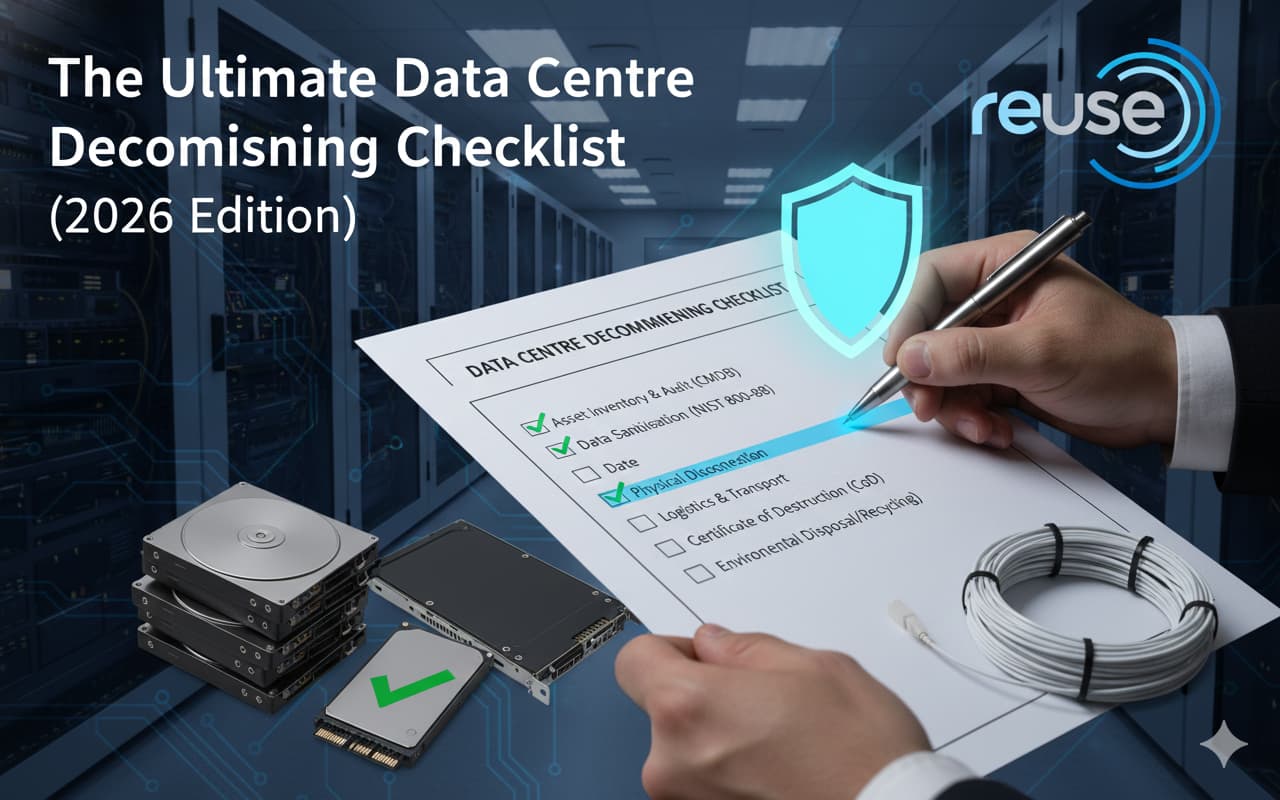
- [ ] Certificate of Data Destruction (listing all serial numbers & AI models)
- [ ] Certificate of Recycling (R2v3/e-Stewards)
- [ ] Transfer of Liability Document
- [ ] Carbon Offset/ESG Report (Scope 3 reporting)