
Enterprise IT Asset Disposition (ITAD): The Strategic Guide & FAQ
12 min read · 9 May 2026
TL;DR
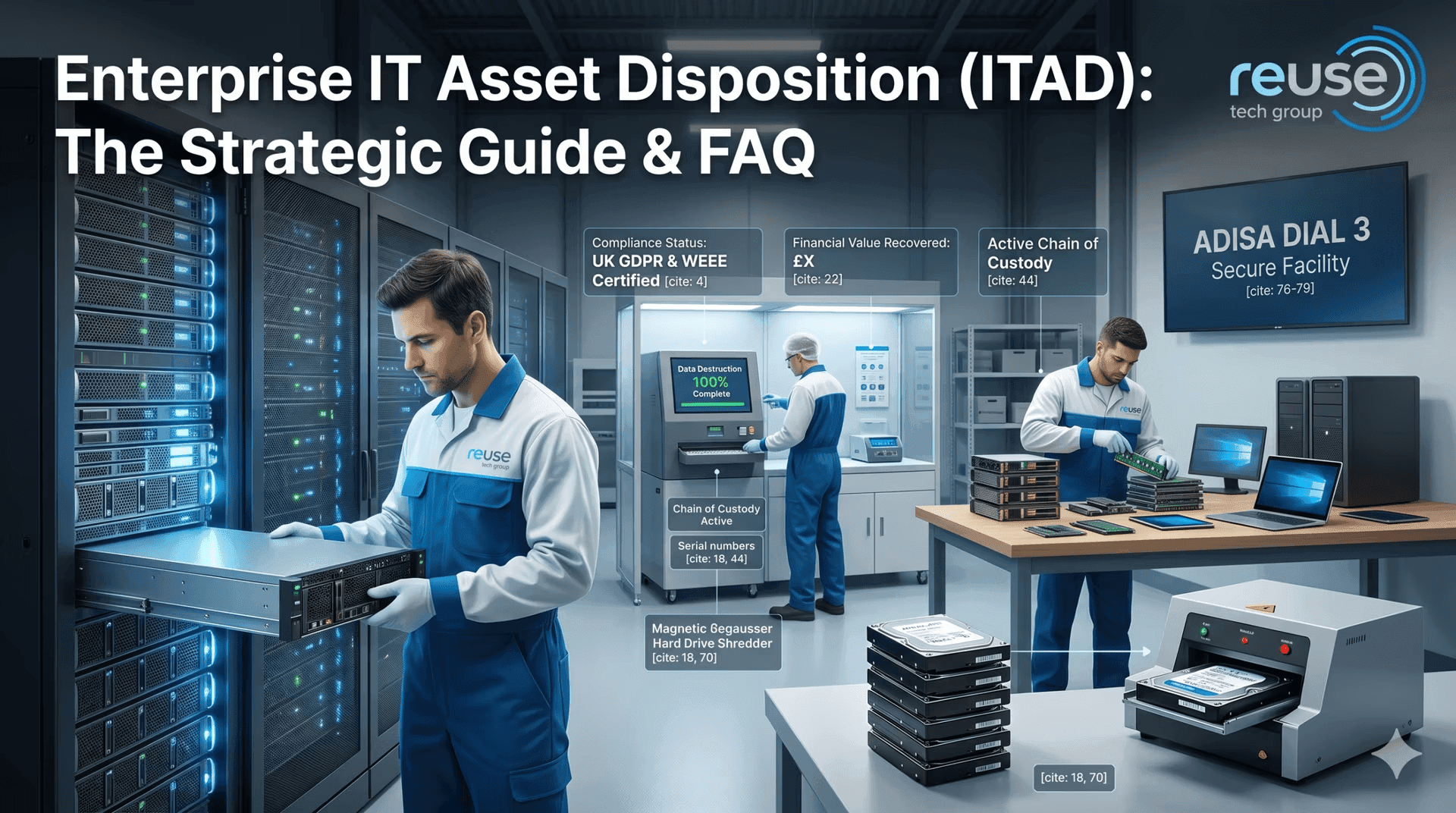
Enterprise IT Asset Disposition (ITAD) is a strategic necessity for UK businesses, extending far beyond simple e-waste recycling. It ensures strict compliance with UK GDPR and WEEE regulations through certified data destruction and secure logistics. Furthermore, a robust ITAD programme recovers maximum financial value from retired hardware, offsetting new technology costs while advancing sustainability goals.
For corporate procurement, IT security, and compliance teams, managing the end-of-life cycle for enterprise hardware has transformed from a basic logistical chore into a critical boardroom imperative. With the UK generating millions of tonnes of electronic waste annually and cyber threats becoming increasingly sophisticated, simply tossing old servers or deleting files from employee laptops is a recipe for disaster.
Modern Enterprise IT Asset Disposition (ITAD) is a highly regulated, strategic process designed to protect sensitive data, ensure strict legal compliance, and recover maximum financial value from retired technology. As organisations navigate the tightening requirements of the UK GDPR and the newly enacted Data (Use and Access) Act 2025, understanding the mechanics of secure hardware disposal is non-negotiable.
This comprehensive guide is designed to dismantle the complexities of asset retirement. By exploring critical operational factors—from managing vendor risks to understanding complex pricing structures—and answering the most pressing secure hardware disposal FAQs, we provide a blueprint for a compliant, profitable, and environmentally responsible ITAD programme.
The Strategic Importance of Professional ITAD
At its core, ITAD refers to the controlled process of decommissioning, sanitising, and responsibly disposing of end-of-life technology. However, it is fundamentally an exercise in risk management and value generation.
When hardware reaches the end of its useful life, the latent risks associated with sensitive corporate data persist. Corporate procurement and IT security teams must work collaboratively to ensure that assets are handled in a way that aligns with three core pillars:
- Data Security and Compliance: The UK General Data Protection Regulation (UK GDPR) mandates that personal data must not be kept longer than necessary and must be processed securely against unauthorised access. Professional ITAD ensures irreversible data destruction through certified software erasure, magnetic degaussing, or physical shredding.
- Environmental Stewardship: The Waste Electrical and Electronic Equipment (WEEE) Regulations 2013 strictly govern how businesses (classed as end-users) must separate and dispose of commercial e-waste. Using licensed treatment facilities prevents hazardous materials from contaminating the environment and supports the circular economy.
- Financial Value Recovery: ITAD is not just a sunk cost. By refurbishing and remarketing functional enterprise assets—such as legacy servers, workstations, and networking equipment—businesses can generate substantial cash rebates to offset the costs of new technology deployments.
Decoding the Economics: The ITAD Quoting Process
For procurement teams tasked with budgeting for asset retirement, understanding how providers calculate their fees is essential. The quoting process for enterprise ITAD is rarely a one-size-fits-all scenario; it relies heavily on the type of equipment, the required security protocols, and the logistical complexities of the collection.
Pricing Models: Per Unit vs. Volume
When assessing a quotation, businesses will typically encounter two distinct pricing architectures. A flat-fee or per-unit pricing model charges a transparent, discrete amount for the collection, wiping, and certification of each asset. In the UK, standard digital data destruction typically incurs a base cost of £2-£8 per asset, which increases if high-security on-site physical shredding is required.
Conversely, large enterprises managing multi-site refresh projects benefit from volume-based pricing or bundled service agreements. Consolidating large volumes of hardware enables the ITAD provider to achieve economies of scale, dramatically lowering the overall per-asset cost.
Rebates and Value Recovery
The quoting phase is also where value recovery is assessed. High-performance processors, memory modules, and RAID controllers are highly sought after in secondary data centre markets. A strategic ITAD partner will calculate a rebate based on the current secondary market demand, the age of the hardware, and refurbishment costs. When optimised effectively, the revenue generated from remarketing can make the entire ITAD programme budget-neutral or even exert a positive impact on the IT department's budget.
Mitigating Third-Party Involvement Risks
Outsourcing hardware disposal to an external vendor is necessary for most large organisations, but third-party involvement introduces severe vulnerabilities into your supply chain. The moment an asset leaves your facility, your organisation remains legally liable as the "Data Controller," while the ITAD vendor acts as your "Data Processor".
Risks associated with third-party IT vendors include catastrophic data breaches due to inadequate facility security, compliance failures stemming from unregulated sub-processors, and severe reputational damage. To actively mitigate these risks, compliance teams must enforce rigorous due diligence.
Chain of Custody and Sub-Processor Auditing
A secure ITAD programme relies on an unbroken chain of custody. This means every asset is individually tracked from the moment of collection through transport, processing, and final disposition, accompanied by unbroken documentation. If a vendor utilises unvetted subcontractors or third-party courier networks, that chain is instantly broken.
Procurement officers must mandate that ITAD vendors use their own highly vetted personnel and proprietary, solid-sided logistics vehicles with live GPS tracking. Furthermore, under the UK GDPR, data controllers must demand total transparency regarding any sub-processors involved in the downstream recycling or data destruction phases, ensuring all parties adhere to the same stringent security standards.
Logistics and Collection Speed SLAs
The physical extraction and transportation of end-of-life hardware represent the highest-risk phase of the ITAD lifecycle. For enterprise environments, the collection process must be seamless, secure, and rigorously defined by Service Level Agreements (SLAs).
Turnaround Times and Data Centre SLAs
Collection speed is a heavily scrutinised metric, particularly during corporate relocations or data centre decommissioning projects where inflexible lease expirations apply. Standard enterprise collections across the UK generally process the hardware, perform certified sanitisation, and issue the final Certificates of Destruction within a 10 to 20 working day turnaround period.
However, in highly concentrated technology hubs, elite ITAD providers offer hyper-localised, rapid-response logistics. For instance, specialised providers servicing the vital data centre corridors in London and Slough can offer SLAs as fast as 4 hours for emergency decommissioning or breach response scenarios.
Complex Infrastructure Extraction
Enterprise collections rarely involve simply picking up boxes from a loading bay. ITAD logistics must accommodate complex requirements, such as floor-to-door lift access, intricate de-installation of enterprise network equipment, and the removal of heavy uninterruptible power supplies (UPS) from deep subterranean server rooms, all executed without disrupting the client's daily commercial operations.
ITAD Frequently Asked Questions: Your Top Queries Answered
To support your internal policy development, we have compiled the ultimate list of ITAD Frequently Asked Questions covering security, compliance, and operational best practices.
- What is the difference between ITAD and standard e-waste recycling? Standard e-waste recycling primarily focuses on breaking down devices to recover raw materials (plastics, metals) and rarely provides a verified chain of custody. ITAD encompasses the full governance process: cryptographic data sanitisation, asset tracking, maximum financial value recovery, regulatory compliance, and the issuance of formal Certificates of Destruction. A recycler manages materials; an ITAD programme manages risk.
- Are standard file deletion or factory resets sufficient for data security? No. This is one of the most dangerous ITAD myths. Deleting a file merely removes the operating system's reference to it; the actual binary data remains on the hard drive and can be easily restored using basic recovery tools. True security requires software-based data erasure that overwrites all storage sectors multiple times, or physical destruction methods like shredding.
- What documentation is required to prove compliance in the UK? For data protection (UK GDPR), you must obtain an itemised Certificate of Destruction or Erasure for every data-bearing asset, containing specific serial numbers and timestamps. For environmental compliance (WEEE), you are legally required to retain a Waste Transfer Note (WTN) for standard commercial waste for at least 2 years, or a Hazardous Waste Consignment Note (HWCN) for hazardous materials (such as lead-acid batteries) for 3 years.
- What accreditations should we look for in an ITAD provider? A credible ITAD partner should hold ISO 27001 (Information Security), ISO 14001 (Environmental Management), and ISO 9001 (Quality Management). Within the UK, the ADISA ICT Asset Recovery Standard 8.0 is the gold standard; it is recognised by the Information Commissioner's Office (ICO) as a UK GDPR-compliant certification scheme for data sanitisation.
- How does the ADISA DIAL rating work? The Data Impact Assurance Level (DIAL) is a framework that allows you (the Data Controller) to determine the exact level of security service required based on your unique risk profile. By assessing the volume of data, the potential impact of a breach, data categories, potential adversaries, and your organisation's risk appetite, you generate a DIAL rating (e.g., highly sensitive government data would require a stringent DIAL 3 rating). The ITAD provider must then deploy the specific logistical and physical countermeasures required to meet that exact rating.
- Do mobile phones and IoT devices need to go through the ITAD process? Absolutely. Consumer electronics, tablets, multifunction printers, and Internet of Things (IoT) devices retain vast amounts of cached network credentials, synchronised data, caller histories, and access to enterprise systems. A mature ITAD policy must universally encompass all data-bearing assets to prevent severe network vulnerabilities.
Conclusion
Implementing a robust Enterprise IT Asset Disposition strategy is no longer an optional administrative task; it is a foundational pillar of modern corporate governance. By understanding the intricate quoting mechanics, aggressively mitigating the risks associated with third-party involvement, and demanding rapid, highly secure collection SLAs, procurement and security teams can transform IT disposal from a compliance burden into a strategic advantage.
Organisations must move beyond the myths of basic file deletion and partner with rigorously accredited experts. By executing certified data destruction and embracing the circular economy through hardware remarketing, UK enterprises can permanently safeguard their critical data perimeters while simultaneously recovering vital capital to fuel future innovation.
Ready to transform your redundant hardware into recovered capital? Request a consultation to secure your data, ensure compliance, and maximise rebates.