
How to Safely Dispose of Laptop and Phone Batteries: New 2026 Laws & Best Practices
8 min read · 25 March 2026
TL;DR
The new UK Li-ion battery disposal laws for 2026 mandate a shift from "best practice" to strict legal compliance for businesses, primarily to combat the "zombie battery" fire crisis. Key changes include classifying batteries as hazardous waste , mandatory Digital Waste Tracking (Oct 2026), and stricter WEEE rules requiring separation from devices. Transport regulations now enforce a 30% State of Charge (SoC) limit for batteries shipped after January 1, 2026. Businesses must adopt specialised storage, use AVD for fire suppression, and partner with licensed hazardous waste carriers to avoid severe fines and prosecution.
TL;DR
The new UK Li-ion battery disposal laws for 2026 mandate a shift from "best practice" to strict legal compliance for businesses, primarily to combat the "zombie battery" fire crisis. Key changes include classifying batteries as hazardous waste, mandatory Digital Waste Tracking (Oct 2026), and stricter WEEE rules requiring separation from devices. Transport regulations now enforce a 30% State of Charge (SoC) limit for batteries shipped after January 1, 2026. Businesses must adopt specialised storage, use AVD for fire suppression, and partner with licensed hazardous waste carriers to avoid severe fines and prosecution.
In 2026, the management of lithium-ion (Li-ion) batteries has moved from a "best practice" recommendation to a strict legal mandate for UK businesses. With the "zombie battery" crisis causing over 200 fires annually at UK recycling plants, the government has introduced sweeping reforms to close regulatory gaps. For safety professionals and facility managers, understanding the updated Li-ion battery disposal regulations is no longer just about environmental stewardship—it is about fire prevention, legal compliance, and avoiding the multi-million-pound fines associated with improper hazardous waste handling.
This guide explores the critical changes in e-waste management rules 2026, the new UK Lithium-ion Battery Safety Bill, and the tactical steps required for safe disposal of laptop batteries and mobile devices in a professional environment.
Why Li-Ion Battery Disposal Laws are Changing in 2026
The landscape of mobile phone battery recycling laws has shifted due to three major regulatory "arrivals":
- The Lithium-ion Battery Safety Bill: This legislation enhances rules for the storage, use, and disposal of batteries, specifically targeting the reduction of fires in waste systems. It introduces stricter requirements for cell chemistry information and disposal instructions to be provided with every battery.
- Mandatory Digital Waste Tracking (October 2026): Starting in late 2024 and becoming fully mandatory for waste-receiving sites in October 2026, the UK is moving to a real-time digital record system. This replaces fragmented paper-based waste transfer notes with a transparent digital footprint from the point of origin to final treatment.
- WEEE Regulations (2025 Amendment): The UK's Waste Electrical and Electronic Equipment (Amendment) Regulations 2025 have strengthened reporting duties. Businesses must now separate batteries from their host devices—like laptops or vapes—and report their weights separately to ensure accurate material recovery.
The Shift from "Universal Waste" to Hazardous Reality
Historically, small batteries were often treated as general e-waste. Under the updated Li-ion battery disposal regulations, these are strictly classified as hazardous waste. They contain flammable electrolytes like lithium hexafluorophosphate (LiPF6) and can enter thermal runaway if crushed or short-circuited during traditional waste collection.
Global Compliance: UK vs EU Regulations 2026
While the UK has its own legislative path, it remains closely aligned with the EU Battery Regulation 2023/1542 to facilitate trade and safety standards.
Battery Regulation & Alignment (2026)
| Requirement | UK Status (2026) | EU Alignment |
|---|---|---|
| Digital Battery Passport | Mandatory for BESS; under review for portables. | Required for industrial/EV batteries (> 2 kWh) by Feb 2027. |
| Material Recovery Targets | 20% critical mineral demand from recycling by 2035. | 50% Lithium recovery by 2027; 80% by 2031. |
| Labeling & QR Codes | UKCA marking and chemistry labeling required. | QR code linking to safety data mandatory by 2027. |
| Removability | Designing for "readily removable" batteries in EEE. | End-user replaceable portables by 2027. |
Handling Li-Ion Batteries Safely: Preventing Thermal Runaway
The core risk of recycling lithium-ion batteries in electronics is thermal runaway—a self-sustaining chemical reaction where temperatures can exceed 700°C to 1000°C in seconds.
Managing Damaged or Defective (DDR) Batteries
For the safety persona, a "swollen" or "pillowed" laptop battery is a high-priority hazard. Lithium battery fire safety handling for DDR units requires an immediate Standard Operating Procedure (SOP):
- Quarantine: Isolate the device in a non-combustible container (like a metal bin) at least 10 metres away from buildings.
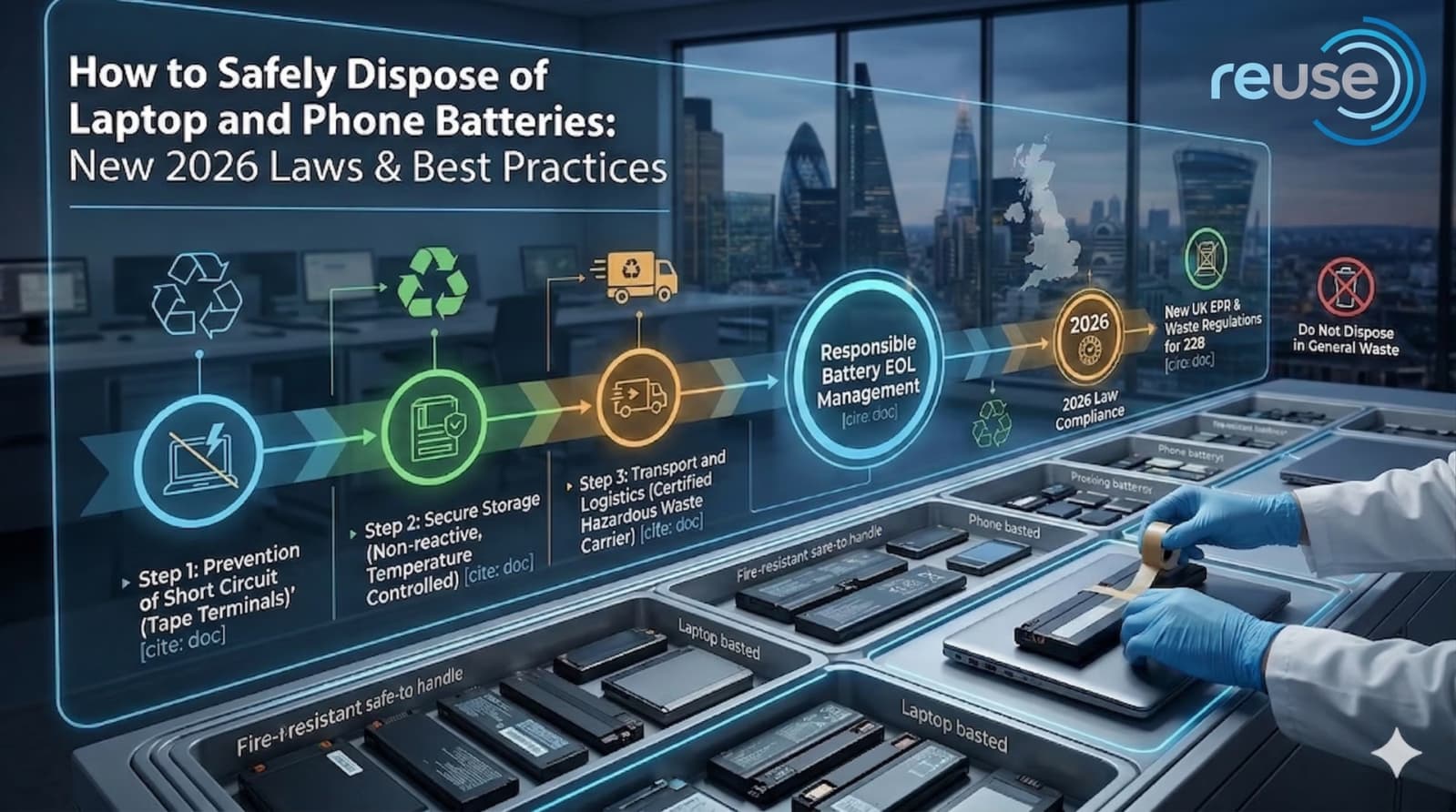
- Terminal Insulation: Tape the terminals of loose batteries with non-conductive tape to prevent short circuits.
- Specialist Containment: Use fire-resistant safety bags or bins filled with vermiculite or sand to provide a thermal barrier.
- Do Not Puncture: Puncturing a swollen battery releases toxic gases and often triggers immediate ignition.
ADR Transport Regulations: The 30% SoC Rule
A major update effective January 1, 2026, concerns the transportation of lithium batteries. The ADR transport regulations and IATA DGR have expanded the 30% State of Charge (SoC) mandate.
Previously, only "loose" batteries (UN 3480) were limited to 30% charge during air transport. From 2026, this applies to batteries packed with equipment and battery-powered vehicles. For road transport in the UK, maintaining a lower SoC (ideally 40–60% for storage, but 30% for shipment of defective units) is recognised as a critical risk mitigation strategy to reduce the energy available for a fire.
ADR Special Provisions to Know:
- SP 188: Applies to "small" laptop/phone batteries (<100 Wh). These are exempt from full dangerous goods documentation but still require the "Battery Mark" and 1.2m drop-tested packaging.
- SP 376: Governs the transport of damaged or defective batteries. These require specialised UN-approved packaging (P911/LP906).
SP 677: A new 2025/2026 provision for "critically defective" batteries. These must be transported as Transport Category 0, meaning they are highly restricted and require specialised dangerous goods carriers.
Best Practices for Workplace Battery Management
To achieve the "gold standard" in compliance, safety officers should implement a tiered approach to battery storage and disposal.
1. Storage Environment
Maintain storage areas between 15°C and 25°C. Extremes of temperature accelerate chemical degradation. Avoid stacking loose batteries, as this increases the risk of terminals touching and short-circuiting.
2. Specialised Fire Suppression
Standard CO2 and water extinguishers are often ineffective against Li-ion fires because the battery produces oxygen during decomposition. Aqueous Vermiculite Dispersion (AVD) is now the recommended agent. It works by cooling the fire and forming a heat-proof mineral film that prevents thermal propagation to adjacent cells.
3. Separation at Source
From April 2026, all businesses must separate WEEE from general waste streams. For batteries specifically, use dedicated, fire-rated metal cabinets rather than plastic bins.
Chemical Recycling: From Waste to "Black Mass"
True recycling of lithium-ion batteries in electronics involves recovering critical raw materials (CRMs) like cobalt, nickel, and lithium. The recycling process typically involves shredding the batteries to produce "Black Mass"—a hazardous dark powder containing these metals.
UK regulators now classify black mass as hazardous, requiring specialised environmental permits for facilities that process it. This "urban mining" is essential for the circular economy, with 2031 targets mandating that new batteries contain at least 6% recycled lithium.
Conclusion: Staying Compliant with E-Waste Management
As we move through 2026, the era of casual battery disposal is over. Li-ion battery disposal regulations in the UK now require a proactive system of digital tracking, specialised storage, and lower charge levels during transport. Failure to follow these duties doesn't just invite environmental harm—it risks prosecution and unlimited fines.
By establishing clear SOPs for safe disposal of laptop batteries, investing in AVD suppression, and partnering with licensed hazardous waste carriers, safety professionals can protect their personnel and ensure their organisation leads the way in responsible, transparent waste management.
Key Takeaways for Safety Professionals
- Check Weights: Batteries under 4kg are "portable"; those over 4kg are "industrial" and have different take-back rules.
- Digital Tracking: Prepare for mandatory digital waste tracking starting October 2026.
- Transport SoC: Ensure any batteries shipped alone or with equipment after Jan 1, 2026, do not exceed 30% State of Charge.
- Fire Safety: Update your Fire Risk Assessment (FRA) specifically for Li-ion hazards under DSEAR 2002.
- FAQ's
Can I put small phone batteries in the office general recycling bin?
No. Batteries are classed as hazardous waste. They must be collected separately to prevent fires in collection trucks.
What is the 30% SoC rule?
As of January 2026, lithium-ion batteries shipped by air (and recommended for road/sea) must not exceed 30% of their rated capacity to minimise fire risk during transit.
What happens if I don't comply with UK battery laws?
Non-compliance can result in formal cautions, unlimited fines, or up to two years’ imprisonment. Large-scale breaches may trigger administrative fines of up to €10 million or 2% of global turnover.
What should I use to extinguish a lithium battery fire?
Specialised agents like Aqueous Vermiculite Dispersion (AVD) are significantly more effective than water or CO2 as they create a thermal barrier to stop propagation.No. Batteries are classed as hazardous waste. They must be collected separately to prevent fires in collection trucks.
As of January 2026, lithium-ion batteries shipped by air (and recommended for road/sea) must not exceed 30% of their rated capacity to minimise fire risk during transit.
Non-compliance can result in formal cautions, unlimited fines, or up to two years' imprisonment. Large-scale breaches may trigger administrative fines of up to €10 million or 2% of global turnover.
Specialised agents like Aqueous Vermiculite Dispersion (AVD) are significantly more effective than water or CO2 as they create a thermal barrier to stop propagation.
Compliance is mandatory. Implement your 2026 Li-ion safety protocols today to prevent catastrophic fires and avoid unlimited fines