
Cisco Switches Reuse: Why This Networking Equipment Holds Exceptional Resale Value in the UK Market?
9 min read · 2 April 2026
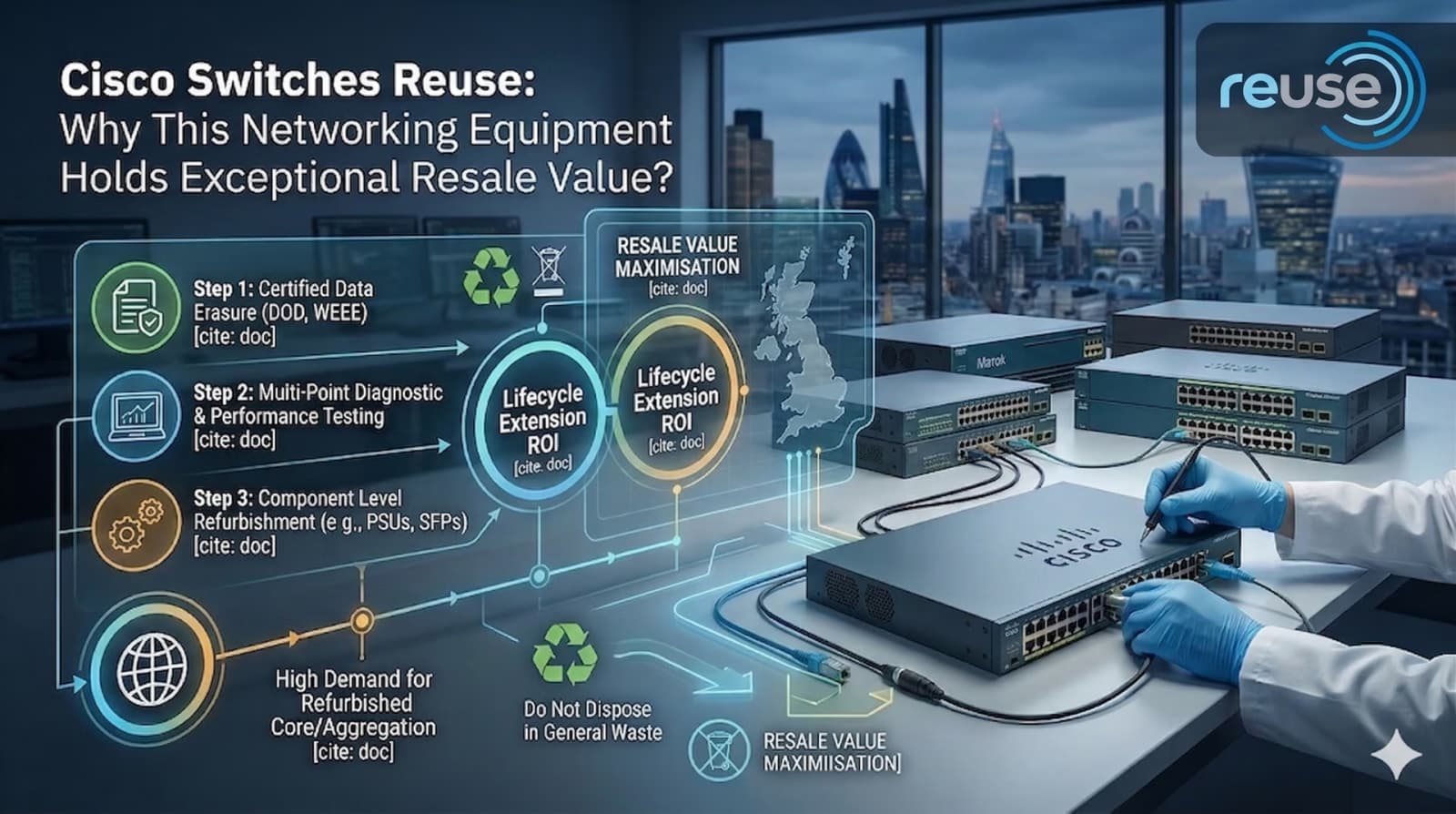
TL;DR
Cisco Catalyst and Nexus switches retain high residual value in the UK due to their carrier-grade reliability and modular design. London enterprises often achieve 50–80% savings with refurbished gear, while asset recovery recovers 10–30% of the lifecycle value. This secondary market is further bolstered by the Defra 2030 sustainability strategy and massive hardware refresh cycles toward the Catalyst 9000 family.
TL;DR
Cisco Catalyst and Nexus switches retain high residual value in the UK due to their carrier-grade reliability and modular design. London enterprises often achieve 50–80% savings with refurbished gear, while asset recovery recovers 10–30% of the lifecycle value. This secondary market is further bolstered by the Defra 2030 sustainability strategy and massive hardware refresh cycles toward the Catalyst 9000 family.
In the high-stakes corridors of London’s Square Mile and the rapidly expanding data centre hubs of the M4 corridor, the role of a network engineer has evolved. It is no longer just about maintaining uptime or configuring OSPF areas; it is about managing the Cisco hardware lifecycle as a strategic financial asset. As we move through 2026, the economics of networking infrastructure have reached a tipping point where Cisco switch resale value isn't just a "nice-to-have" recovery—it’s a fundamental pillar of IT procurement strategy.
Why is it that a decommissioned Cisco Catalyst or Nexus switch retains a price tag that makes other enterprise hardware look like disposable consumer electronics? The answer lies in a perfect storm of carrier-grade engineering, a massive global install base, and a UK regulatory environment that now mandates circular economy practices.
The "Cisco Premium": Engineering for a Second Life
The primary driver of networking equipment resale value is the hardware's sheer durability. Unlike general-purpose servers that may burn out under the heat of AI workloads, Cisco's core portfolios—specifically the Catalyst and Nexus lines—are engineered for "carrier-grade" reliability.
Cisco hardware is designed to survive the "infant mortality" phase of electronics. In fact, many senior engineers in the UK argue that a refurbished Cisco switch is more reliable than a brand-new one because it has already been "burnt-in" and survived years of operation in a climate-controlled data centre.
Modular Architecture and Parts Harvesting
Cisco’s move toward modularity has significantly bolstered residual value. In fiscal 2024, Cisco reported that 88% of its power supply units (PSUs) were replaceable on-site. For a London-based refurbisher, this means a chassis with a failed power supply isn't e-waste; it’s a five-minute fix away from being production-ready. Furthermore, 89% of Cisco products can now be disassembled into individual components, facilitating a robust market for "part harvesting" where modules and fans are sold to support legacy environments.
Macro-Economic Drivers in the London Tech Hub
The UK data centre networking market is projected to grow from USD 1.35 billion in 2025 to over USD 2.07 billion by 2031. This growth is particularly concentrated in London and South-East England, where power grid constraints are forcing organisations to maximise the efficiency of every rack unit.
In this environment, refurbished Cisco hardware offers a dual advantage:
- Immediate Availability: While new hardware often faces lead times due to semiconductor shortages, the secondary market provides next-day shipping for high-demand models.
- CapEx Optimisation: UK enterprises can achieve savings of 50% to 80% off original equipment manufacturer (OEM) pricing by opting for used switches.
For a network engineer at a Canary Wharf firm, these savings allow for the reallocation of budget toward high-priority AI pilots or cybersecurity enhancements without sacrificing the reliability of the underlying network.
The "Great Refresh": From Legacy to Catalyst 9000
We are currently in the midst of what Cisco CEO Chuck Robbins has called a "multi-year, multibillion-dollar campus networking refresh cycle". Organisations are migrating en masse from legacy platforms like the Catalyst 2960-X and 3850 to the Catalyst 9000 family to support AI-driven workloads and Wi-Fi.
Why Legacy Gear Still Holds Value
You might expect the market to be flooded with "valueless" older gear, but the Cisco Catalyst vs Nexus value remains surprisingly stable. Older models like the 2960-X are still considered "tanks"—simple, reliable access-layer switches that are perfect for lab environments, small businesses, or edge deployments where 100G uplinks aren't yet a requirement.
A five-year-old Catalyst 2960 can still fetch between £60 and £200, depending on the port count and condition. This residual value allows IT departments to offset the high costs of moving to the newer Catalyst 9300 or 9300X series, which feature the SiliconOne ASIC and 400G capabilities.
Sustainability and the "Defra" Mandate
In the UK, selling used networking gear is no longer just about the money; it’s about compliance. The Waste Electrical and Electronic Equipment (WEEE) Regulations 2013 require businesses to prioritise reuse over recycling.
Perhaps the most significant shift comes from the Defra Digital Sustainability Strategy 2025-2030. This government strategy sets an ambitious target: 80% of end-user devices in the public sector must be refurbished or remanufactured by 2030. It also mandates a 32% reduction in e-waste and a zero-to-landfill policy.
This top-down pressure has trickled into the private sector. Major London financial institutions now include sustainability weightings of up to 15% in their digital procurements. Buying used Cisco switches isn't just a budget win—it's an ESG (Environmental, Social, and Governance) victory that must be reported in the annual Purpose Report.
The Licensing Hurdle: Navigating Smart Licensing in 2026
While the physical hardware is durable, the secondary market faces challenges with Cisco’s transition to subscription-based models. Modern switches utilise Smart Licensing Using Policy (SLP), which shifts the focus from hardware-locked keys to cloud-managed reporting.
Network engineers looking to buy or sell must be aware of these three factors:
- Non-Transferability: Cisco software licenses (DNA/Catalyst subscriptions) are generally non-transferable without specific consent and potentially a license fee.
- Feature Lock: Without an active subscription, advanced automation features in the Catalyst Centre may be inaccessible, though the switch will continue to perform basic "Network Essentials" L2/L3 functions.
Relicensing Fees: Secondary-market buyers often need to acquire a new license from Cisco, which can add cost but ensures the hardware is eligible for SmartNet support.
Competitive Landscape: Why Cisco Still Leads in Liquidity
While Arista Networks has taken significant market share in the high-frequency trading (HFT) and hyperscale data centre sectors—holding roughly 18.9% of the data centre Ethernet market—Cisco remains the "gold standard" for enterprise liquidity.
Arista's Extensible Operating System (EOS) and CloudVision platform are highly praised for their programmability and single-binary simplicity. Similarly, Juniper’s (HPE) Mist AI is a leader in automated troubleshooting. However, the Cisco switch market is larger due to the UK's massive pool of Cisco-certified engineers. Every network engineer from Soho to Shoreditch knows the Cisco CLI, which creates a universal demand that Arista and Juniper cannot yet match in the broader enterprise secondary market.
Best Practices for IT Asset Disposition (ITAD)
To maximise the return on your decommissioned gear, a structured approach to IT asset disposition (ITAD) is essential. Research shows that hardware retired within 3 to 4 years retains the strongest value, returning approximately 28% of its original cost. After the four-year mark, value drops at a rate of 2% to 4% per month.
5 Tips for Maximising Resale Value:
- Don't Let Gear Gather Dust: Decommission and sell your switches immediately after a refresh. Every month in storage is a 2-4% loss in capital.
- Keep the Accessories: Original rack ears, power cables, and especially modular uplinks (SFP/SFP+) significantly increase the "Grade A" appeal of the unit.
- Certified Data Destruction: Ensure you receive a Certificate of Data Destruction that complies with NIST 800-88 R1 standards. This is non-negotiable for GDPR compliance in the UK.
- Use Specialist UK Vendors: Work with London-based firms like Flux IT or Reuse Tech Group, who offer 24-hour collection in the City or Canary Wharf, reducing logistics headaches.
- Document Everything: Maintain records of serial numbers and original purchase dates. Buyers pay more for equipment with a clear chain of custody.
Summary: A Strategic Shift
For the modern UK network engineer, Cisco switches are more than just packets and ports—they are recoverable capital. By leveraging the high resale value of Cisco switches, organisations can fund the transition to the AI era while meeting stringent UK environmental targets. Whether you are buying refurbished gear to stretch a tight budget or selling off a legacy fleet to fund a move to the Catalyst 9300X, understanding the secondary market is now a core technical skill.
- FAQ's
Is it legal to sell Cisco hardware with the software included?
You can legally sell the physical hardware, but the software license (IOS/IOS XE) is generally considered non-transferable. The buyer must typically relicense the software through Cisco to be fully compliant and eligible for support.
How do I know if my used switch is counterfeit?
Counterfeits often have duplicated serial numbers. It is best to buy from reputable UK vendors who perform stringent inspection and testing. Using Cisco Refresh (Cisco’s official remanufacturing program) is the safest way to guarantee authenticity.
Does refurbished gear have a higher failure rate?
No. Properly tested refurbished switches have already bypassed the “infant mortality” phase. Statistics suggest they are often just as reliable as new units, provided they have undergone a rigorous 5+ hour testing process.
Can I get SmartNet support on a second-hand switch?
Yes, but only after a Cisco inspection and relicensing process. Alternatively, many third-party vendors in London offer their own warranties (often up to 2 years) that rival Cisco’s standard support.
Which Cisco models are currently in the highest demand?
The Catalyst 9200 and 9300 series are currently the “hot” items as enterprises modernise. However, legacy 3850 and 2960-X models remain highly liquid for smaller branch offices and lab environments.
You can legally sell the physical hardware, but the software license (IOS/IOS XE) is generally considered non-transferable. The buyer must typically relicense the software through Cisco to be fully compliant and eligible for support.
Counterfeits often have duplicated serial numbers. It is best to buy from reputable UK vendors who perform stringent inspection and testing. Using Cisco Refresh (Cisco's official remanufacturing program) is the safest way to guarantee authenticity.
No. Properly tested refurbished switches have already bypassed the "infant mortality" phase. Statistics suggest they are often just as reliable as new units, provided they have undergone a rigorous 5+ hour testing process.
Yes, but only after a Cisco inspection and relicensing process. Alternatively, many third-party vendors in London offer their own warranties (often up to 2 years) that rival Cisco’s standard support.
The Catalyst 9200 and 9300 series are currently the "hot" items as enterprises modernise. However, legacy 3850 and 2960-X models remain highly liquid for smaller branch offices and lab environments.
Maximise your recoverable capital. Your decommissioned Cisco switches lose 2-4% of their value monthly—contact us today to lock in your IT asset disposition (ITAD) return and meet UK sustainability goals