
WEEE vs. GDPR: Resolving the Conflict Between Data Security and Recycling
11 min read · 8 April 2026
TL;DR
UK compliance officers face a major conflict: balancing the UK GDPR's strict data erasure mandates against the WEEE Regulations ' demand for electronic asset reuse. Fearing massive fines, many organisations needlessly shred functional hardware, severely harming the environment. The strategic solution is certified data sanitisation. This forensically erases data to satisfy security laws while preserving physical assets for sustainable, compliant reuse.
TL;DR
UK compliance officers face a major conflict: balancing the UK GDPR's strict data erasure mandates against the WEEE Regulations' demand for electronic asset reuse. Fearing massive fines, many organisations needlessly shred functional hardware, severely harming the environment. The strategic solution is certified data sanitisation. This forensically erases data to satisfy security laws while preserving physical assets for sustainable, compliant reuse.
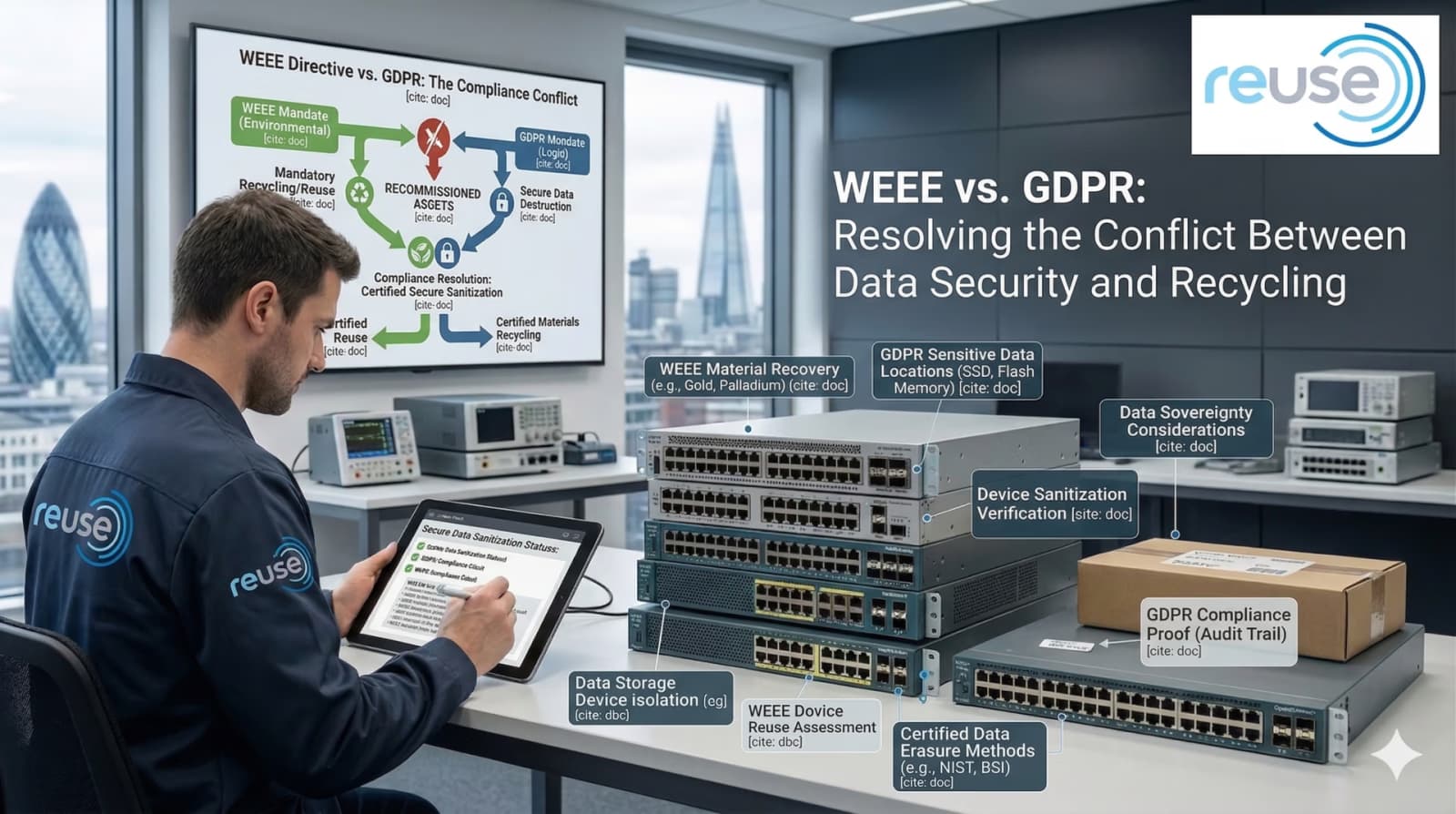
One of the most persistent and operationally complex battles currently playing out in corporate IT departments is the WEEE vs GDPR conflict. On one hand, the UK General Data Protection Regulation (UK GDPR) demands the absolute destruction of personal data when it is no longer needed. On the other hand, the Waste Electrical and Electronic Equipment (WEEE) Regulations require us to divert electronic waste from landfill and to prioritise the reuse of assets.
For years, risk-averse IT and procurement teams have responded to this tension with a blunt instrument: physically shredding fully functional laptops, servers, and hard drives. While shredding guarantees the data is gone, it actively sabotages your organisation's environmental targets and generates entirely avoidable carbon emissions.
Today, corporate boards demand both ironclad information security and demonstrable environmental, social, and governance (ESG) progress. You can no longer afford to sacrifice one for the other. This article explores the anatomical conflict between these two regulatory behemoths and explains how verified data sanitisation serves as the ultimate strategic bridge, enabling you to achieve fully GDPR compliant e-waste disposal while championing the circular economy.
The Information Security Imperative: The True Cost of Residual Data
To understand why IT asset disposal data security is such a high-stakes issue, we must first look at the legal obligations governing data protection. Under the UK GDPR, the principle of storage limitation dictates that personal data must only be kept for as long as necessary.
When hardware reaches the end of its life, it triggers Article 17 of the UK GDPR, commonly known as the "Right to Erasure" or the "right to be forgotten". This article explicitly grants individuals the right to have their personal data erased without undue delay when it is no longer required. However, the Information Commissioner's Office (ICO) has made it abundantly clear that simply deleting files or restoring a device to factory settings does not legally constitute "erasure". Unencrypted data left on a hastily formatted drive is easily recoverable by forensic tools, leaving your organisation exposed to catastrophic breaches.
The regulatory environment became significantly more perilous with the passing of the Data (Use and Access) Act 2025 (DUAA). While the DUAA introduced some minor relaxations regarding low-risk cookies and scientific research, it fundamentally changed the enforcement landscape for electronic communications. Previously, fines under the Privacy and Electronic Communications Regulations (PECR)—which cover things like cookies and communication logs—were capped at £500,000. The DUAA aligned these penalties directly with the UK GDPR, raising the maximum fines to £17.5 million or 4% of global annual turnover.
The stakes for improper hardware decommissioning are not theoretical. In a landmark global case, the financial institution Morgan Stanley contracted a moving company with no specific ITAD expertise to dispose of decommissioned servers. The vendor failed to wipe the servers before reselling them, exposing 15 million clients' personal information. The resulting regulatory fallout totalled over $155 million in fines and class-action settlements. Closer to home, a UK hospital trust was fined £325,000 by the ICO after un-wiped hard drives were stolen and sold online by an employee of the very company contracted to destroy them.
Under the law, you cannot outsource your liability. Even when you hand your retired hardware over to an IT asset disposal (ITAD) vendor, you remain the Data Controller. If a breach occurs downstream, the ICO will hold your organisation accountable.
The Environmental Mandate: The Circular Economy and WEEE
Operating in direct parallel to data privacy laws are the UK's environmental regulations. The global electronic waste crisis is expanding rapidly; the UK alone generated 1.65 million tonnes of e-waste in 2022, averaging 24.5 kg per person—one of the highest per capita rates in the world.
The WEEE Regulations 2013 were enacted to combat this crisis by strictly regulating how electrical and electronic equipment (EEE) is disposed of, setting aggressive targets for recovery and recycling. In 2025, the UK government introduced sweeping amendments to the WEEE framework. These updates vastly increased importer responsibilities and forced online marketplace operators to finance the collection and recycling of waste EEE. The government also set a demanding household WEEE recycling target of 517,285 tonnes for 2025.
The core objective of the WEEE directive is to protect the environment by prioritising the preparation for reuse and the extension of a product's lifecycle over destructive recycling. However, a highly specific regulatory nuance complicates this: Persistent Organic Pollutants (POPs). Historically, chemicals like polybrominated diphenyl ethers (PBDEs) were used as flame retardants in electronic plastics. UK guidance strictly dictates that any WEEE containing POPs cannot be reused; it must be destroyed.
Crucially, however, the legislation provides a vital exemption. Products manufactured after 1 January 2009 are legally presumed to be highly unlikely to contain PBDEs. Therefore, if an IT asset was manufactured post-2009, it is primed for environmentally sustainable reuse within the UK—provided the data residing upon it can be safely and legally neutralised.
The Clash: Security Paranoia vs. Sustainable Practice
The intersection of these two regulatory behemoths creates the WEEE vs GDPR conflict. Fearing the wrath of the ICO and multi-million-pound DUAA fines, Chief Information Security Officers (CISOs) often default to the physical destruction of all storage media—industrial shredding, crushing, or high-intensity degaussing.
While shredding solves the GDPR problem by obliterating the data, it simultaneously destroys the asset, severely undermining the organisation's WEEE obligations. Comprehensive industry surveys reveal that up to half of all end-of-life enterprise assets are routinely destroyed rather than repurposed, and alarmingly, up to 47% of destroyed data centre assets were fully operational at the time they were shredded.
This reliance on destruction is an ESG disaster. The carbon footprint of IT hardware is heavily skewed toward the manufacturing phase. A recent, peer-reviewed scientific study by Cranfield University dramatically quantified this impact, finding that remanufactured laptops produce only 6.34% of the CO2 emissions generated by manufacturing a brand-new equivalent device. Every time your organisation shreds a functional post-2009 laptop out of a disproportionate fear of a data breach, you force the procurement of a new device, triggering massive, entirely avoidable Scope 3 carbon emissions.
Data Sanitisation: The Ultimate Bridge
To resolve this conflict, compliance officers must transition their organisations away from the crutch of physical destruction and towards verified logical sanitisation.
Data sanitisation (or data sanitisation) is the process of using certified software algorithms to systematically overwrite every addressable sector of a storage device with random data, followed by mandatory verification. When executed to internationally recognised standards, software erasure renders the data forensically unrecoverable while leaving the physical hardware perfectly intact and ready for resale, charitable donation, or internal redeployment.
To ensure ITAD compliance and legally defensible erasure under Article 32 (Security of Processing) of the UK GDPR, your processes must align with contemporary frameworks:
- NIST 800-88 standards: The US National Institute of Standards and Technology Special Publication 800-88 (Revision 2) provides the gold-standard governance framework for establishing an enterprise media sanitisation programme. It helps organisations make risk-based decisions on whether to "Clear," "Purge," or "Destroy" media.
- IEEE 2883-2022: Because modern flash-based Solid State Drives (SSDs) and NVMe architectures handle data differently than old magnetic hard drives, traditional overwriting methods are often ineffective. The IEEE 2883-2022 standard bridges this gap by providing highly specific, media-level technical requirements necessary to execute secure purge commands on modern storage technologies.
By mandating that your ITAD vendor utilises software that conforms to these standards, you satisfy the GDPR's Right to Erasure without sacrificing the physical asset.
Achieving ITAD Compliance: The 2026 CRTF Landscape
Writing an ITAD policy is only half the battle; the other half is vetting the third-party processors who handle your hardware decommissioning.
Historically, highly regulated UK enterprises relied on the National Cyber Security Centre's (NCSC) CAS-S (Commodity Assurance Service – Sanitisation) scheme to vet their ITAD vendors. However, facing an evolving threat landscape, the NCSC has fundamentally reformed its assurance model. Moving into 2026, the NCSC has transitioned to the Cyber Resilience Test Facilities (CRTF) network, underpinned by Principles-Based Assurance (PBA).
The CRTF scheme eliminates static, pass/fail certificates in favour of continuous, evidence-led resilience testing. Under this new paradigm, vendors face infinitely deeper operational scrutiny, evaluating not just their software, but their physical site security, staff vetting procedures, and end-to-end chain of custody. If physical destruction is necessary (e.g., for failed drives), the new CRTF standards demand much stricter tolerances, often requiring particles to be shredded to less than 2mm to ensure total irrecoverability.
For commercial enterprises, mandating that your ITAD partner is vetted under the NCSC CRTF framework—or strictly adheres to the ICO-approved ADISA ICT Asset Recovery Standard 8.0—provides the legally defensible audit trail required to prove compliance in the event of an investigation.
Concluding Summary
The perceived conflict between the data security mandates of the UK GDPR and the environmental recycling targets of the WEEE Directive is a false dichotomy. You do not have to choose between protecting your data and protecting the planet.
While the Data (Use and Access) Act 2025 has raised the financial stakes of a data breach, reacting by blindly shredding functional IT hardware is an environmentally and commercially reckless strategy. By implementing a robust IT asset disposal policy built on certified software data sanitisation, aligned with NIST 800-88 and IEEE 2883-2022 standards, and executed by CRTF- or ADISA 8.0-vetted vendors, you can achieve the best of both worlds. You can definitely neutralise the threat of catastrophic ICO penalties while aggressively reducing your organisation's Scope 3 carbon footprint through the compliant reuse of technology.
Top Tips for Secure & Sustainable Hardware Decommissioning
- Appoint an Asset Disposal Champion: As recommended by joint ICO and Environment Agency guidance, designate a specific senior individual (like an IT Security Manager) to maintain accountability over the disposal lifecycle.
- Maintain a Strict CMDB: Your Configuration Management Database (CMDB) is your first line of defence. Ensure every device is meticulously logged (make, model, serial number, and asset tag) before it leaves the building.
- Demand Granular Erasure Certificates: Never accept a generic "certificate of recycling." A legally defensible Certificate of Erasure must link directly to your CMDB, detailing the specific device serial number, the exact sanitisation standard used (e.g., NIST Purge), and a timestamp of the verification pass.
- Stop Shredding Functional Assets: Unless a drive has physically failed or contains Top Secret defence data, default to software-based data erasure to preserve the asset's value and slash your carbon emissions.
- Audit Your Vendors: Treat your ITAD partner as a high-risk data sub-processor. Demand proof of ADISA 8.0 certification, GPS-tracked logistics, and secure, access-controlled processing facilities.
- FAQ's
What is GDPR compliant e-waste disposal?
GDPR compliant e-waste disposal refers to the secure retirement of end-of-life IT assets in a manner that permanently eradicates personal data to satisfy Article 17 “Right to Erasure,” while simultaneously adhering to the environmental processing requirements of the WEEE Regulations. It relies on a documented chain of custody and verifiable data erasure certificates.
How do we resolve the WEEE vs GDPR conflict?
The conflict is resolved by moving away from physical hardware destruction and adopting certified logical data sanitisation. This software-based approach securely overwrites data, fulfilling the strict security requirements of the UK GDPR, while leaving the physical device intact so it can be compliantly reused or remarketed in line with WEEE hierarchy targets.
What are the NIST 800-88 standards?
NIST SP 800-88 (Revision 2) is a globally recognised set of guidelines published by the US National Institute of Standards and Technology. It helps organisations build governance-driven enterprise media sanitisation programmes, offering a risk-based framework to decide whether storage media should be Cleared, Purged, or Destroyed before disposal or reuse.
Why is ITAD compliance important for ESG reporting?
Under new UK sustainability reporting frameworks, organisations are increasingly required to report on their Scope 3 greenhouse gas emissions and their waste management strategies. Proper ITAD compliance—prioritising asset reuse over shredding—can reduce hardware lifecycle carbon emissions by up to 70%, providing highly favourable and verifiable metrics for mandatory ESG reports.
GDPR compliant e-waste disposal refers to the secure retirement of end-of-life IT assets in a manner that permanently eradicates personal data to satisfy Article 17 "Right to Erasure," while simultaneously adhering to the environmental processing requirements of the WEEE Regulations. It relies on a documented chain of custody and verifiable data erasure certificates.
The conflict is resolved by moving away from physical hardware destruction and adopting certified logical data sanitisation. This software-based approach securely overwrites data, fulfilling the strict security requirements of the UK GDPR, while leaving the physical device intact so it can be compliantly reused or remarketed in line with WEEE hierarchy targets.
NIST SP 800-88 (Revision 2) is a globally recognised set of guidelines published by the US National Institute of Standards and Technology. It helps organisations build governance-driven enterprise media sanitisation programmes, offering a risk-based framework to decide whether storage media should be Cleared, Purged, or Destroyed before disposal or reuse.
Under new UK sustainability reporting frameworks, organisations are increasingly required to report on their Scope 3 greenhouse gas emissions and their waste management strategies. Proper ITAD compliance—prioritising asset reuse over shredding—can reduce hardware lifecycle carbon emissions by up to 70%, providing highly favourable and verifiable metrics for mandatory ESG reports.
Caught between GDPR data destruction mandates and WEEE recycling targets? We can bridge the gap.
Complete our contact form today to get a tailored, audit-ready IT Asset Disposal strategy for your organisation.